
Ocean Shark Inn
Guesthouse island in Gnaviyani. Its reef is measured from satellite; guest reviews live on the booking sites.
Book Ocean Shark Inn
Check availability for Ocean Shark Inn. One tap opens the hotel on a booking site, where you’ll see the live price and choose your dates, rooms and guests.
Prices & availability by Stay22, updated live. We may earn a referral — never a placement, and it never affects a score.
House reef & underwater
Ocean Shark Inn · Gnaviyani · a shared island reef
Excellent house reef
Reef Conditions · top 12% of the 297 reefs we have measured
Shore entry Measured
~518 m across the lagoon to the drop-off — a genuine swim, not a wade.
Living cover Measured
About 56% of the mapped reef reads as living coral or algae from satellite.
Heat history Measured
Peak heat stress 4.72 DHW since the imagery, 1 bleaching-alert year on record (2016).
From satellite this reef reads Excellent — roughly 56% living cover. We have not surveyed it in the water, so fish counts and big-encounter ratings stay pending. We don't estimate them.
Reef data modelled from Allen Coral Atlas benthic & geomorphic maps (CC BY 4.0) and NOAA Coral Reef Watch. No in-water survey — every figure above is a measurement. Marine icons: game-icons.net (CC BY 3.0).
Tiger shark
Year-round, and the only known aggregation of its kind in the Maldives. Over 230 individuals have been identified and the population is strongly female-biased (around 84%), with adult females staying about two months at a time and returning year after year. It appears to be a reproductive area, not a passing-through spot.
Oceanic manta ray
Peaks March to May. Fuvahmulah accounts for roughly 86% of all oceanic manta sightings recorded in the Maldives — a different animal from the reef mantas of Baa and Ari, and far harder to find anywhere else in the country.
Pelagic thresher shark
Year-round, mainly September to March, at what is the only known thresher cleaning station in the western Indian Ocean.
Scalloped hammerhead
Two windows: roughly February to May, and again October to December.
Whale shark
Peaks February to April, from a smaller and female-biased record of around 90 identified individuals.
Turtles — no atoll-level seasonal study exists; treat them as year-round residents rather than a season
The monsoon side-rule does not apply here — Fuvahmulah is a lone platform with no lagoon, and wave action matters more than tidal currents
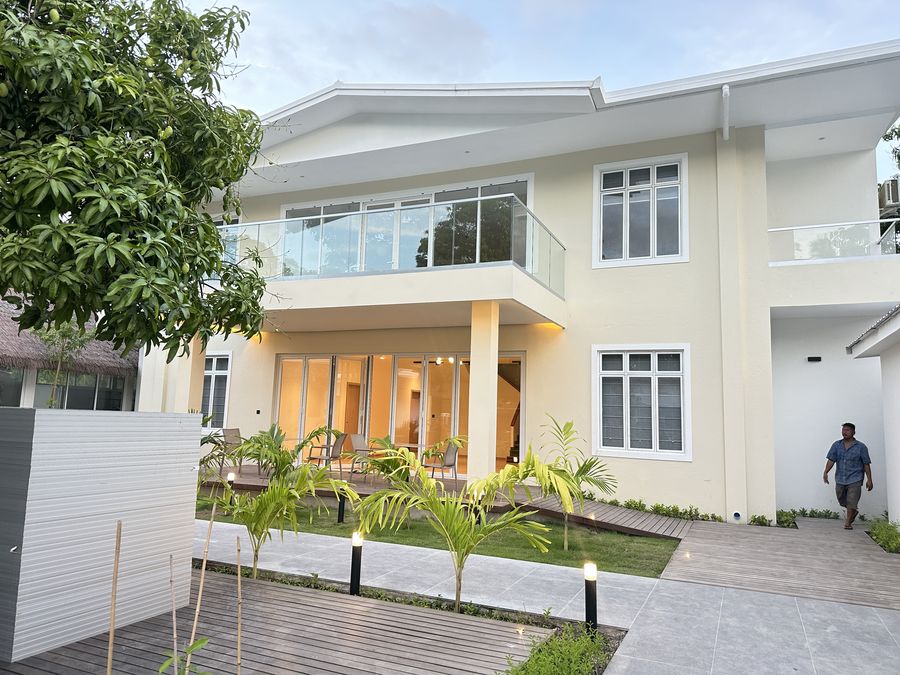
Photos
Where it is
-0.29484, 73.42406The pin is the island centroid from our geocoding, not the building — properties on the same island share it. Satellite imagery © Esri, Maxar, Earthstar Geographics.